


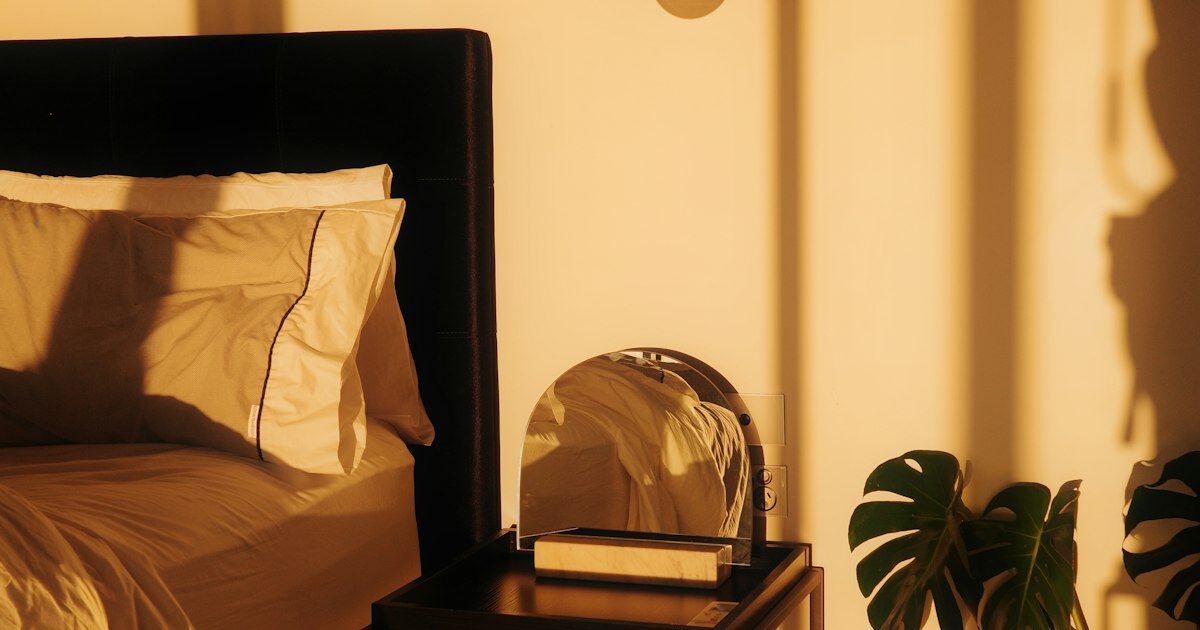
Human biology evolved over millions of years under a singular, predictable celestial rhythm: bright, blue-enriched daylight at midday, followed by the amber, firelit glow of sunset, and total nocturnal darkness. Today, the modern domestic environment shatters this biological cadence. We spend our evenings bathed in 5,000-Kelvin recessed ceiling downlights and glowing television screens, bathing our retinas in daytime wavelengths hours after the sun has set.
This artificial light pollution disrupts human chronobiology, sabotaging deep restorative sleep, elevating nighttime cortisol, and compromising metabolic health. Fortunately, circadian home lighting design bridges the gap between modern residential living and human physiology. By tuning Correlated Color Temperature (Kelvin), controlling light delivery angles, and modulating Equivalent Melanopic Lux (EML), you can transform your home into an environment that energizes your mornings and naturally prepares your brain for sleep. Below is your complete architectural circadian blueprint.
1. Photobiology: Intrinsically Photosensitive Retinal Ganglion Cells (ipRGCs)
For decades, lighting designers assumed the human eye functioned solely for conscious vision via rods and cones. However, chronobiological breakthroughs revealed a third class of ocular photoreceptors: Intrinsically Photosensitive Retinal Ganglion Cells (ipRGCs). These specialized neural cells do not contribute to visual image formation; instead, they serve as biological light meters wired directly to the suprachiasmatic nucleus (SCN)—the master circadian clock in the hypothalamus.
According to chronobiology research from the National Institute of General Medical Sciences (NIGMS), ipRGCs contain a photopigment called melanopsin that exhibits peak sensitivity to narrow-band blue-cyan light wavelengths between 460 and 490 nanometers. When 480nm photons strike melanopsin, the SCN receives a high-alert signal that suppresses pineal melatonin secretion and triggers daytime alertness.
In the evening, even modest exposure to blue-enriched white light—as little as 30 to 50 lux from an overhead fixture—delays melatonin onset by up to ninety minutes, fragmenting rapid eye movement (REM) sleep and leaving you groggy upon waking. Aligning domestic lighting with biological rhythms requires matching spectrum and intensity to the time of day.

2. Correlated Color Temperature (CCT) and Spectral Shifting
The first parameter in circadian architectural design is Correlated Color Temperature (CCT), measured in Kelvins (K). Lower Kelvin numbers indicate warm, amber tones, while higher numbers represent cool, blue-tinted daylight:
- Morning to Midday Phase (5,000K – 6,500K / 400–600 Lux): Early daytime requires high-intensity, full-spectrum illumination rich in 480nm wavelengths to anchor the circadian master clock, spike morning cortisol, and stimulate mental sharpness.
- Late Afternoon Transition (3,000K – 3,500K / 200–300 Lux): As natural twilight approaches, shift interior ambient lighting to neutral white, reducing melanopic stimulation while maintaining visual acuity for household tasks.
- Evening Pre-Bed Phase (1,800K – 2,200K / under 50 Lux): Post-sundown lighting should mimic biological firelight and candlelight. Warm amber wavelengths contain virtually zero 480nm blue photons, allowing natural melatonin synthesis to peak uninterrupted.
According to lighting design standards published by the Illuminating Engineering Society (IES), domestic spaces should implement smart lighting controls or dedicated amber evening circuits that automatically step down color temperatures across twilight transitions, eliminating harsh manual switching.

3. Spatial Geometry: The Horizon Line Rule
Color temperature is only half the circadian equation; equally critical is the angle of light incidence. Because our evolutionary ancestors looked up at the sky during the day and down at hearth fires at night, human ipRGC photoreceptors are heavily concentrated in the inferior (lower) hemisphere of the retina. This means they are structurally primed to receive light arriving from above the horizontal eye-level horizon.
High-elevation overhead lighting—such as recessed ceiling spotlights and center-room chandeliers—strikes the lower retina with maximum efficiency, triggering false daytime alertness regardless of bulb wattage. To establish a biologically harmonious evening environment, adopt the “Below the Horizon” lighting rule:
After sunset, turn off all overhead ceiling fixtures completely. Illuminate your living spaces exclusively using luminaires positioned below eye level (36 to 48 inches from the floor): weighted table lamps, baseboard wash fixtures, low credenza accent lights, and directional floor reading lamps. This geometry shields your inferior retinal photoreceptors from direct photon impact, allowing your brain to transition into restorative sleep mode.
4. Managing Digital Displays and High Color Rendering (CRI)
While fixing architectural ambient lighting transforms your broader room environment, digital screens—smartphones, laptops, and ultra-high-definition televisions—pose an intense, concentrated challenge. A typical modern OLED or LED television held six feet from your eyes emits sharp, high-energy spectral spikes at 450 to 460 nanometers, directly stimulating melanopsin-containing ipRGC cells even if your floor lamps are dimmed to an amber glow.
To neutralize screen interference without abandoning modern technology, configure automated nighttime display filters across all personal devices. Enable built-in night shift or f.lux software to warm screen palettes to 2,700K starting two hours before bedtime. For living room television viewing, adhere to the 10:1 luminance contrast ratio: never watch a bright screen in pitch-black darkness, as the stark contrast strains pupillary muscles and forces extreme photon concentration onto the retina.
Instead, install an indirect 2,200K LED bias lighting strip along the rear perimeter of your television frame. The soft ambient wall wash softens contrast boundaries and prevents eye fatigue while keeping melanopic lux safely below biological activation thresholds.
5. Circadian Lighting Specification and Photometric Matrix
Review the exact photometric targets, fixture elevations, and spectral profiles for primary diurnal phases across residential living spaces:
| Diurnal Phase | Target Color Temp (K) | Ambient Illuminance (Lux) | Fixture Elevation Zone | Target Biological Response |
|---|---|---|---|---|
| Morning Awakening (6 AM – 9 AM) | 5,000K – 6,500K | 500 – 800 Lux | High ceiling / direct window daylight | Cortisol spike, resets SCN master clock, clears sleep inertia |
| Midday Focus (9 AM – 4 PM) | 4,000K – 5,000K | 350 – 500 Lux | Overhead ambient + direct task | Sustained alertness, high cognitive processing, pupil constriction |
| Twilight Wind-Down (4 PM – 8 PM) | 2,700K – 3,000K | 100 – 150 Lux | Mid-level pendants and wall sconces | Gradual decline in central stimulation, eases eye strain |
| Evening Rest (8 PM – 11 PM) | 1,800K – 2,200K | 20 – 50 Lux | Below eye level (lamps, floor washes) | Pineal melatonin release, core temperature drop, prepares deep sleep |
6. Integrating Circadian Lighting with Holistic Home Wellness
Circadian lighting operates as an essential component of a broader restorative domestic lifestyle. Pair your low-Kelvin evening lighting scheme with our science-backed sleep architecture in building a calming evening routine for restful sleep and mental clarity to support deep nocturnal recovery.
In the morning, complement your bright daylight awakening by stepping into a dedicated mindfulness sanctuary, designed using our blueprint on how to design a dedicated morning coffee and mindfulness nook. Finally, balance daytime natural illumination across darker interior spaces by applying architectural optics from our guide to maximizing natural light in dim interior rooms.